

![[NEW – FIND PhD Thesis] Developing Advanced Sensors for Nuclear Accident Monitoring Using Metal-Organic Frameworks](images/news/news5.webp)
Nuclear accidents, although extremely rare, pose significant risks to both human health and the environment. The ability to detect and monitor the release of radioactive species from the nuclear fuel as quickly as possible can give precious information for the management of such situations. This is the central focus of the Ph-D thesis of Mrs. Ana Maria Trofin, that aims to develop innovative instrumentation for the detection of radioactive agents during nuclear severe accidents.
Research Focus: Detecting the Invisible
During a severe nuclear accident, radioactive gases, such as molecular iodine (I2), may be released inside the containment of a nuclear reactor. Detecting these gases can support decision-making, both for onsite accident management and offsite emergency response. While several technologies exist today for detecting radioactive gases, they show limitations that prevent their use under severe accident conditions.
“Our aim is to improve the selectivity and sensitivity of radioactive gas detection under accident conditions, which has significant added-value for emergency response” explains Ana Maria TROFIN, PhD student working on this thesis at the ASNR, under the joint supervision of the thesis directors Prof. Christophe VOLKRINGER[1] and DR. Yannick COFFINIER[2], as well as of Dr. Koffi Jean-Baptiste ALLOKO[3], acting as tutor.
This doctoral research seeks to overcome these limitations by investigating the use of Metal-Organic Frameworks (MOFs) for the selective detection of radioactive agents, and particularly molecular iodine (I2).
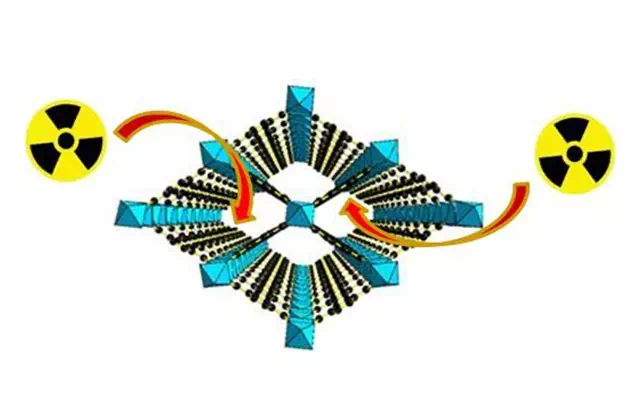
Figure 1 - Picture illustrating the capture of radioactive species by a Metal-Organic Framework (MOF)
Indeed, MOFs are porous materials known for their exceptional ability to concentrate tiny quantities of chemical species due to their high specific surface (up to 7 000 m2/g). Additionally, MOFs are also known for having a functionalizable framework that can be tailored to immobilize specific molecules, meaning the MOFs can trap and hold target molecules within their pores, enabling precise and selective detection in nuclear environments. They are also extremely resistant to irradiation.
Building on these properties, this thesis work will focus on the manufacture of nanometric MOFs, specifically designed for molecular iodine, and which can be adapted to already existing detector technologies. Other gases of interest like Xenon may also be considered. Indeed, Xenon, along with other radioactive noble gases, are crucial indicators for the real-time monitoring of a nuclear accident's progression.
Research Collaboration and Methodology : a Complementary Team Work
This thesis project will be carried out on the Villeneuve d’Ascq university campus and the Cadarache research centre (ASNR) in France and involves collaboration between three research teams:
- One team from the Unit of Catalysis and Solid-State Chemistry (UCCS), under the coordination of Prof. Christophe Volkringer, will focus on the manufacture of nanometric MOFs capable of capturing radioactive agents.
- One team from the Institute of Electronics, Microelectronics and Nanotechnology (IEMN), under the coordination of DR. Yannick Coffinier, will work on manufacturing specific sensors.
- The laboratory of Experimentation in Environment and Chemistry of ASNR, under the tutorship of Dr. Koffi Jean-Baptiste Alloko, will test the sensor in representative conditions.
The sensors’ resistance to accident conditions will also be evaluated in the IRMA irradiator operated by ASNR in Saclay. To know more about the IRMA irradiator and irradiation campaigns, read our last article “Testing Nuclear Instrumentation for Safety: FIND 2026 Irradiation Campaign”.
1. Prof. Christophe VOLKRINGER, Full Professor at Centrale Lille Institute, Honorary Member of the French University Institute and associated to the Unit of Catalysis and Solid-State Chemistry (UCCS)
2. DR. Yannick COFFINIER, Research Director at CNRS and associated to the Institute of Electronics, Microelectronics and Nanotechnology (IEMN)
3. Dr. Koffi Jean-Baptiste ALLOKO, Researcher at the Nuclear Safety and Radioprotection Authority (ASNR)